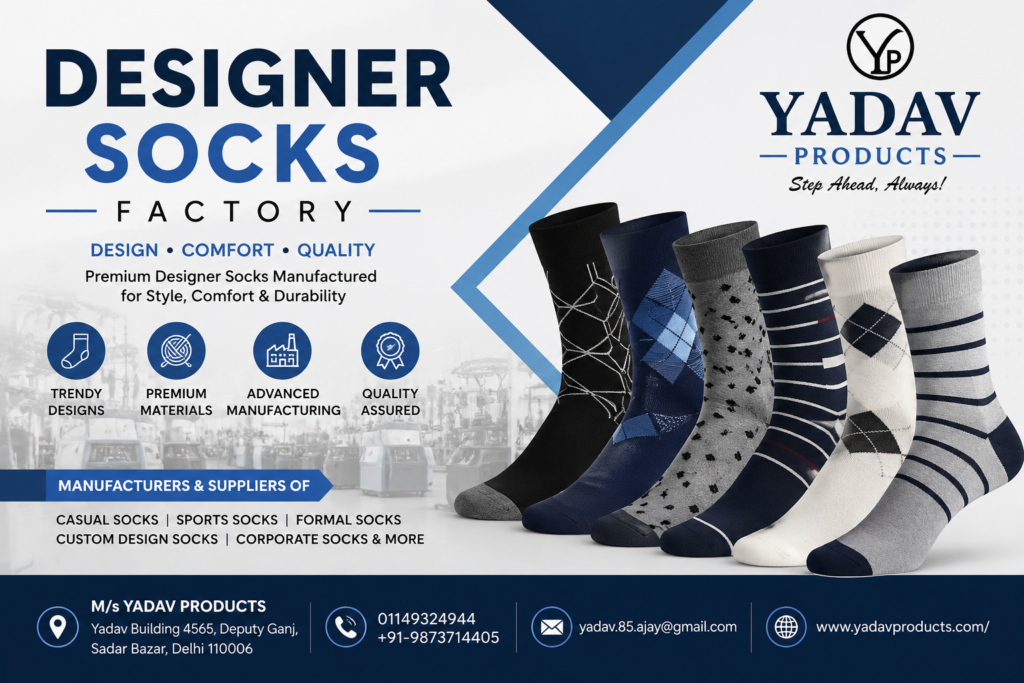
A school supplier and a sports brand need completely different things from a designer socks factory. Here’s how requirements shift by industry — and what to specify when you order.
A capable designer socks factory produces different sock types — cushioned sports socks, durable school uniform socks, breathable formal socks, and branded fashion socks — each requiring different yarn, knit density, and finishing. Yadav Products has manufactured across all these categories from a single Delhi facility since 1986.
Most buyers searching for a Designer Socks Factory assume the product is fairly standard — knit a pattern, pick a colour, done. In practice, what a school supplier needs from a sock is almost nothing like what a sports brand or an export client needs. Getting this wrong is one of the most common sourcing mistakes we see, and it usually shows up months later as returns or reorders that don’t perform the way the first batch did.
At Yadav Products, we’ve supplied socks across nearly every one of these sectors since 1986 — school uniforms, sports lines, corporate formalwear, private label fashion, and export orders. This guide breaks down what actually differs by industry, so you can brief your factory correctly the first time.
Why Sock Requirements Differ by Industry
Three variables drive almost all of the difference between sock categories: knit density, cushioning zones, and yarn composition. A sock built for eight hours of classroom wear needs different reinforcement than one built for a 90-minute match or a single evening at a formal event.
Buyers who order without specifying these variables usually get a “standard” sock that underperforms for their actual use case — not because the factory did anything wrong, but because nobody defined the requirement.
Sock Types Compared
| Sock Type | Primary Buyer | Key Requirement |
| School Uniform | School suppliers, distributors | Durability, colourfastness, uniform sizing |
| Sports/Cushioned | Sports brands, retailers | Zoned cushioning, moisture control, arch support |
| Formal/Corporate | Corporate buyers, distributors | Fine gauge knit, consistent colour, breathability |
| Fashion/Ankle | Fashion brands, private label | Design flexibility, trend-responsive colourways |
| Export | Importers, export clients | Market-specific sizing, compliance documentation |
School Suppliers: Durability Over Design
School uniform socks face the toughest wear-and-wash cycle of any category — daily use, repeated washing, and minimal tolerance for colour fading or shrinkage across a school year. Design variety matters far less here than consistency across a large repeat order.
Best practice for this category: reinforced heel and toe knitting, pre-shrunk cotton or cotton-blend yarn, and a locked colour standard so reorders three months later still match the first batch exactly. Buyers in this segment should ask specifically about wash-test results, not just initial sample quality.
Sports Brands: Cushioning and Fit
Sports and athletic socks need targeted cushioning at the heel and forefoot, moisture-wicking yarn, and often compression zones around the arch. A flat, uncushioned knit will underperform regardless of how good the colourway looks.
A factory experienced in this category should be able to explain their cushioning construction — terry looping density, zone placement — rather than just confirming the sock is “cushioned.” That specificity is usually the difference between a sock that performs and one that just looks athletic.
Corporate & Formal Buyers: Consistency
Formal and corporate sock orders prioritise a fine, even knit gauge and precise colour matching — navy, black, and grey shades need to look identical across every unit in a bulk order. Buyers in this category are usually less price-sensitive and more quality-sensitive than other segments.
The most common mistake here is approving a sample under one lighting condition and receiving bulk stock that reads slightly differently under office lighting. Requesting a colour-matched sample under multiple light sources avoids this.
Fashion Brands & Exporters: Design and Compliance
Fashion and private label brands need a factory that can iterate quickly on design — new colourways, seasonal patterns, and packaging updates without long re-tooling delays. Design flexibility matters more here than in any other category.
Exporters have a different priority entirely: sizing standards and compliance documentation specific to the destination market. A design that works domestically may need re-grading for international sizing conventions, and export shipments typically require additional documentation your factory should already be familiar with.
Material Selection by Use Case
| Use Case | Recommended Material | Reason |
| School Uniforms | Cotton blend | Durable, cost-effective, easy to standardise |
| Sports Socks | Cotton-spandex or bamboo blend | Stretch recovery plus moisture control |
| Formal Socks | Combed cotton | Fine gauge, smooth finish, breathable |
| Premium Fashion | Bamboo or bamboo blend | Softness and sustainability positioning |
Why Yadav Products Fits Multiple Sectors
Yadav Products has manufactured socks in Delhi since 1986, supplying school suppliers, sports brands, corporate buyers, fashion labels, and export clients from a single production facility. This range matters because cross-sector experience means our production team already understands the specific requirements each category demands — cushioning construction for sports, wash durability for schools, fine-gauge consistency for formalwear, and sizing compliance for export.
In-house knitting and dyeing keep quality control consistent across every category we produce, rather than varying by which subcontractor handled a particular order.
Frequently Asked Questions
1. Can one factory produce both school and sports socks well?
Yes, provided the factory has separate knit programs for each — the construction requirements are different enough that a single generic setup won’t serve both well.
2. What makes sports socks different from regular cotton socks?
Sports socks use zoned cushioning, moisture-wicking yarn, and often stretch fibres for compression — features not needed in standard everyday socks.
3. Why do school uniform socks need special durability testing?
They undergo daily wear and frequent washing across a full school year, so colour and shape retention matter more than in most other categories.
4. What should exporters specify beyond material and design?
Destination-market sizing standards and compliance documentation, both of which vary by country and should be confirmed before production begins.
5. Is bamboo suitable for sports socks?
Yes, often blended with spandex for stretch, since bamboo’s natural moisture-wicking properties work well for athletic use.
6. How do formal sock requirements differ from casual socks?
Formal socks need a finer knit gauge and tighter colour consistency, since they’re typically ordered in solid, professional shades viewed under office lighting.
7. Do fashion brands need higher MOQs than other categories?
Not necessarily higher, but they often need more frequent design changes, which requires a factory comfortable with shorter production cycles per design.
8. What’s the biggest sourcing mistake buyers make across categories?
Ordering a generic sock spec without defining the actual use case, which leads to underperformance even when the factory executes the order correctly.
Visit: https://www.yadavproducts.com/
Call: +91 98737 14405
Email: Yadav.85.ajay@gmail.com
Address: M/s Yadav Products Socks Manufacturer & Trader 4565, Deputy Ganj, Sadar Bazaar, Delhi 110006