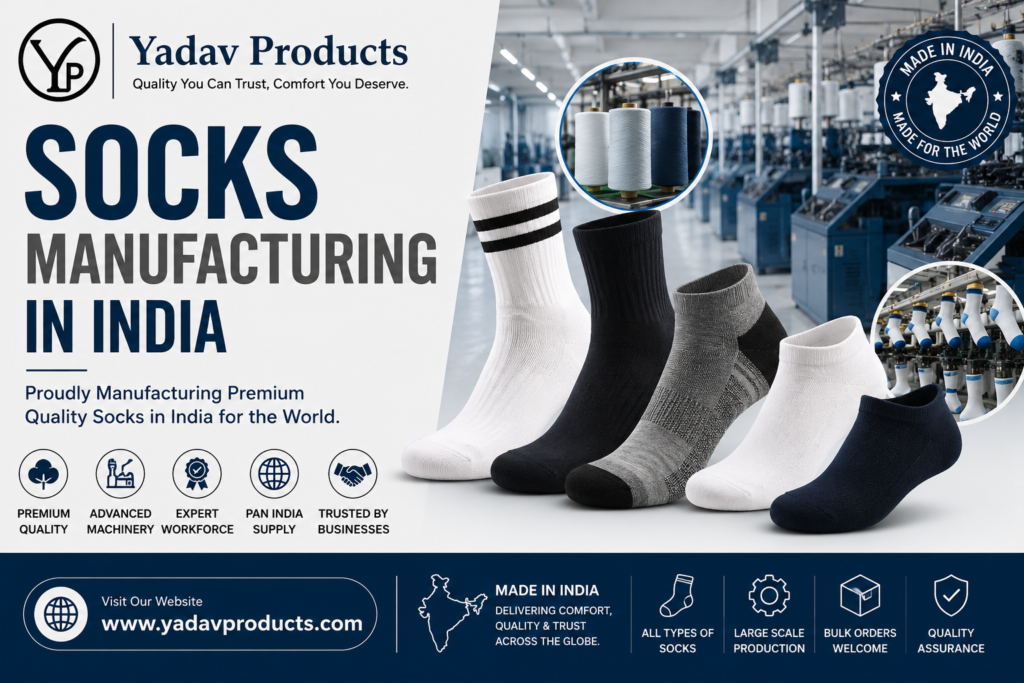
A few months back, a young entrepreneur from Bengaluru messaged us with a simple question: “I want to start my own sock brand, but I have no idea where to begin. Do I need to buy a machine? How many pairs do I have to order? Is this even possible for a small business like mine?”
If you’ve ever typed “how to start a sock brand in India” into Google at 1 AM, this blog is for you. Private label manufacturing has quietly become one of the easiest ways for small business owners, D2C startups, and even retail shop owners to launch their own branded product line — without owning a single machine or hiring a single tailor.
At Yadav Products, we’ve spent years working behind the scenes with brands you’ve probably already worn without knowing it. In this guide, we’ll walk you through everything — what private label Socks Manufacturing in India actually means, how the process works, what MOQ (Minimum Order Quantity) really means for your budget, and how to avoid the mistakes most first-timers make.
What Is Private Label Socks Manufacturing, Really?
Let’s keep this simple. Private label manufacturing means a factory (like ours) makes the product — the socks — and you put your own brand name, logo, and packaging on it. You don’t need a factory. You don’t need machines. You don’t even need manufacturing experience.
Think of it like this: a bakery bakes bread, and a supermarket puts its own store label on the bag before selling it. The bread is the same great quality, but the branding is entirely the retailer’s. Socks manufacturing in India works exactly the same way — hundreds of clothing brands, gyms, hotels, corporate gifting companies, and e-commerce sellers use private label socks manufacturers to build their own product lines.
India, especially clusters in Tirupur, Kolkata, and parts of Punjab, has become a go-to hub for this. Combined with reliable cotton supply, skilled labour, and competitive pricing, it’s no surprise that India has grown into a serious socks exporter from India, shipping to the US, UK, Europe, and the Middle East.
Why Businesses Prefer Private Labeling Over Starting Their Own Factory
Setting up a knitting unit requires heavy capital, technical know-how, and years of learning curve. Private labeling skips all of that. You focus on branding, marketing, and selling — we focus on stitching, quality control, and delivery.
Understanding MOQ: The Question Everyone Asks First
MOQ, or Minimum Order Quantity, is usually the very first thing that scares away new business owners — and honestly, it shouldn’t. Most people assume they need to order in lakhs of pairs to even start a conversation with a manufacturer. That’s simply not true anymore, especially with manufacturers who work with growing brands.
MOQ exists because production isn’t like printing a single T-shirt on demand — knitting machines, dyeing units, and packaging lines need a certain batch size to run efficiently and keep your per-unit cost reasonable.
Typical MOQ Ranges in the Indian Socks Industry
| Order Type | Typical MOQ (Pairs) | Best Suited For |
| Single Design, Single Color | 300–500 | First-time brands, testing the market |
| Multiple Designs/Sizes | 1,000–2,000 | Growing D2C brands, boutique stores |
| Custom Fabric/Yarn | 3,000–5,000+ | Established brands, corporate/bulk orders |
| Export Orders | 10,000+ | International buyers, wholesale distributors |
Note: These figures are indicative averages in the Indian socks manufacturing industry and vary slightly based on manufacturer, fabric type, and design complexity.
At Yadav Products, we’ve kept our starting MOQs beginner-friendly because we genuinely believe small brands deserve the same manufacturing quality as big ones — without needing big-brand budgets on day one.
Key Benefits of Private Label Socks Manufacturing
- Low entry barrier: Start your own sock brand without owning any machinery.
- Faster time to market: Skip years of setup and start selling within weeks.
- Full branding control: Your logo, your packaging, your story — the product just happens to be made by an expert factory.
- Quality consistency: Established manufacturers already have tested processes, so quality doesn’t fluctuate order to order.
- Scalability: Start small, then scale production as your brand as one of the best socks brands in India grows.
- Export readiness: Many Indian manufacturers already meet international compliance standards, useful if you eventually want to export.
The Step-by-Step Process: How Private Label Socks Are Made
Here’s where most guides get vague. Let’s break the actual journey down — from your first email to the finished box of socks landing at your doorstep.
Process Flow Table
| Step | What Happens | Approx. Time |
| 1. Consultation | Discuss your requirements, budget, and design ideas | 1–2 days |
| 2. Design & Sampling | Yarn, color, and pattern samples are prepared for approval | 5–10 days |
| 3. Sample Approval | You review, request tweaks, and give final go-ahead | 2–5 days |
| 4. Bulk Production | Knitting, dyeing, stitching, and quality checks begin | 10–20 days |
| 5. Branding & Packaging | Your logo tags, labels, and custom packaging are added | 3–5 days |
| 6. Quality Check & Dispatch | Final inspection followed by shipping to your location | 2–4 days |
On average, a full production cycle takes 3 to 5 weeks depending on order size and design complexity.
Tips for Choosing the Right Socks Manufacturing Partner
- Ask for real samples, not just catalog photos. Fabric feel matters more than pictures.
- Check their fabric sourcing. Good manufacturers are transparent about cotton, bamboo, or synthetic blends used.
- Understand their MOQ flexibility. A good partner adjusts MOQ based on your growth stage, not just their convenience.
- Look for compliance certifications if you plan to sell internationally as a socks exporter from India.
- Ask about lead times honestly. Reliable manufacturers give realistic timelines, not “we’ll try our best” answers.
Do’s and Don’ts of Private Label Socks Manufacturing
| Do’s | Don’ts |
| Order a sample batch before bulk production | Don’t skip sampling to “save time” |
| Clearly share your size chart and target market | Don’t assume “standard size” is universal |
| Ask for fabric composition in writing | Don’t rely only on verbal promises |
| Plan your budget including packaging costs | Don’t forget branding costs while calculating MOQ budget |
Common Mistakes First-Time Brand Owners Make
We’ve seen this journey from the front row, and honestly, most mistakes are avoidable with a little guidance.
- Ordering too much, too soon. Testing the market with a smaller batch first saves money and stress.
- Ignoring fabric quality for cheaper pricing. Customers notice comfort long before they notice your logo.
- Not planning packaging in advance. Packaging delays can push your entire launch timeline back.
- Choosing a manufacturer based only on price. The cheapest quote isn’t always the most reliable one.
- Skipping a written agreement. Clear terms on timelines, quality, and payments protect both sides.
Quick Reference Cheat Sheet
| Question | Quick Answer |
| Minimum order for beginners? | Usually starts around 300–500 pairs |
| Time to launch a new brand? | Roughly 3–5 weeks from sampling to delivery |
| Can I request custom packaging? | Yes, most manufacturers offer this at low MOQs too |
| Is export possible from small orders? | Yes, though export MOQs are typically higher |
Frequently Asked Questions
1. What is the minimum order quantity for private label socks in India?
It typically starts around 300–500 pairs for a single design, though this can vary by manufacturer and fabric choice.
2. How long does socks manufacturing in India usually take?
From sampling to final delivery, most orders take between 3 to 5 weeks, depending on design complexity and order size.
3. Can a small business really become one of the best socks brands in India?
Absolutely. Many successful Indian socks brands started with small private label orders before scaling up.
4. Do I need any manufacturing experience to start my own sock brand?
No. Private labeling is designed exactly for people without a manufacturing background — the factory handles production while you handle branding.
5. Is it possible to export private label socks internationally?
Yes, many Indian manufacturers are equipped to work as a reliable socks exporter from India, though export orders usually require higher MOQs and compliance documentation.
6. What fabrics are commonly used in Indian socks manufacturing?
Cotton, cotton-spandex blends, bamboo fiber, and terry fabric are among the most commonly used materials, chosen based on comfort and target use case.
Final Thoughts
Starting your own sock brand might feel overwhelming at first, but as you can see, the process is far more approachable than most people expect. With the right Indian socks brand manufacturing partner, a clear understanding of MOQ, and a bit of patience through the sampling stage, your idea can genuinely turn into a real, sellable product line.
At Yadav Products, we’ve walked this path with dozens of brands — some starting with just a few hundred pairs and growing into recognizable names. If you’re exploring socks manufacturing in India and want a partner who explains things clearly instead of hiding behind jargon, we’d love to have that first conversation with you.
Ready to build your own sock brand? Reach out to Yadav Products today and let’s talk MOQs, designs, and timelines — no pressure, just honest guidance.
or business decisions. This post does not constitute professional, legal, or business advice.
Call: +91 98737 14405
Email: Yadav.85.ajay@gmail.com
Address: M/s Yadav Products Socks Manufacturer & Trader 4565, Deputy Ganj, Sadar Bazaar, Delhi 110006